
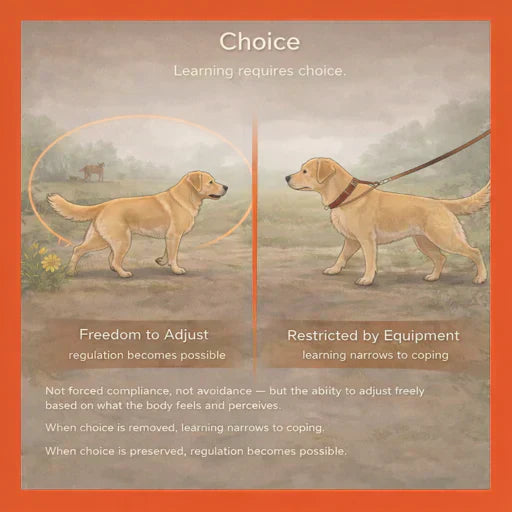
Why is choice important for how dogs learn?
Quick summary
Pulling reduces when a dog can stay in the learning loop and adjust by choice — not by force.
Pulling doesn’t stop because movement is blocked.
It stops when regulation replaces impulse.
For that to happen, the dog needs to remain involved in the full learning loop. This usually means they can:
- Feel the first urge to move
- Receive feedback that isn’t threatening or overwhelming
- Stay regulated enough for thinking to engage
- Make their own adjustment in response
When the body isn’t busy fighting restraint or pressure, the nervous system has space to settle. Attention can remain on the environment rather than on the equipment. In that state, learning unfolds naturally — through experience, not enforcement.
This is where choice becomes essential.
Learning requires the ability to adjust freely based on what the body feels and perceives. Not forced compliance. Not avoidance. But genuine choice.
When choice is removed, behaviour may change — but learning narrows to coping. The dog learns how to avoid pressure, reduce discomfort, or comply to make things stop. The impulse itself remains untouched.
When choice is preserved, something different happens. The dog can feel the impulse rise, stay regulated, and decide how much movement is appropriate. Regulation becomes internal rather than imposed.
This is why lasting change looks quiet.
No dramatic correction.
No constant management.
No escalating tools.
Just a dog who no longer needs to pull — because they’ve learned how to settle the urge from within.
Key Takeaways
- Pulling reduces when the learning loop stays intact
- Regulation requires freedom from overwhelming pressure
- Choice allows impulses to be resolved internally
- Lasting change comes from learning, not control
FAQs
Does this mean dogs should never be guided?
Guidance matters — but it must preserve the dog’s ability to choose.
Why does blocking movement fail long term?
Because it removes choice and interrupts learning.
What does real progress look like?
Quieter adjustments, fewer reactions, and less need for intervention.