
Can commands or treats interfere with how dogs learn on walks?
Quick summary
Using the S-K9 is mostly about not interfering — so the learning loop can do its work.
The S-K9 ChestCollar doesn’t ask the handler to do more.
It asks the handler to step back.
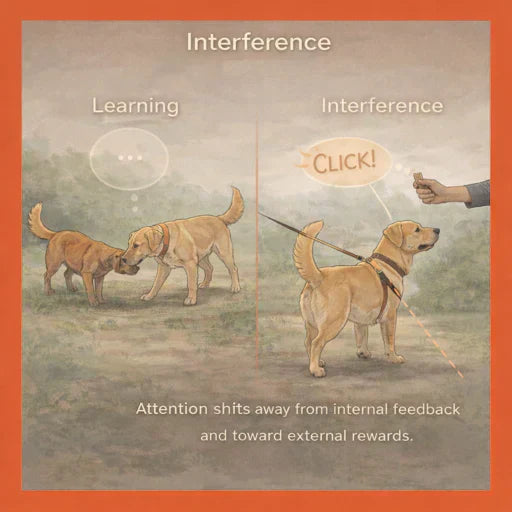
Your role is simple: hold the lead, stay present, and allow the dog to feel what happens in their own body as movement begins and settles. There’s no need to add commands, corrections, treats, or physical blocking. Those additions often redirect attention away from the very sensations the dog needs to process.
When the handler remains calm and neutral, the dog can stay focused on internal feedback rather than reacting to instructions or rewards. This preserves the natural sequence where impulse can soften into regulation — and regulation into choice.
This is why pulling often reduces without force.
Nothing is being managed away.
Nothing is being overridden.
The dog feels the first urge to move, notices the change in their body, and adjusts from within. Learning happens in real time because the loop remains intact.
This requires trust — not in a method, but in the dog’s capacity to regulate when nothing interferes.
That’s what interference really is.
Interference doesn’t need to be harsh. Even well-timed cues, encouragement, or rewards can interrupt a dog’s ability to feel and adjust internally. Attention shifts outward. The body stops listening to itself.
With the S-K9, learning often emerges not because something is added — but because something unnecessary is removed.
The quieter the handler becomes, the clearer the feedback loop gets.
And when there is nothing left to fight, pulling has no reason to continue.
Key Takeaways
- The handler’s role is to avoid interrupting learning
- Calm, neutral presence preserves the learning loop
- Interference can be subtle — not just forceful
- Learning often improves when less is added
FAQs
Should I give commands while using the S-K9?
No. Commands redirect attention away from internal feedback.
What if my dog seems unsure at first?
Allow time. Regulation develops through feeling and adjustment.
Is doing nothing really doing something?
Yes. Removing interference allows learning to surface naturally.